Henry James on sacrifice
The Parallax ViewHenry James on sacrifice is not treated merely as a celebrated novelist but as a materialist thinker whose fiction tests what an act of renunciation can mean in a world without transcendent guarantees. Across stories of artistic representation, fidelity, and advice, his characters confront choices that cannot be reduced to conventional morality or rewarded by a higher order. The book returns to these scenes to connect literary form with its account of minimal difference, autonomy, and the strange possibility of giving something up for nothing.
Place in the Book
Henry James on sacrifice runs through the book’s first major discussion of materialist theology and receives a dedicated interlude, titled Kate’s Choice, or, the Materialism of Henry James. In this structure, the fiction is not an ornamental illustration added after the philosophical argument. Its dilemmas become a way of thinking through what remains when religious transcendence is unavailable: a person may still renounce what matters, but the act cannot be explained as a transaction with a divine authority or as proof of a moral rule.
The discussion links the novels and stories to different problems rather than making them one continuous narrative. The Real Thing supplies a case of representation and minimal difference; The Portrait of a Lady becomes a test of autonomy and the meaning of a decision; and The Lesson of the Master turns literary authority into a problem of ethical advice and sacrifice. Together, these readings give Henry James on sacrifice a distinctive role in the book: his fiction makes abstract philosophical tensions visible in choices whose significance remains unsettled.
Representation and the Minimal Difference
In The Real Thing, a painter-narrator hires Major and Mrs. Monarch, impoverished aristocrats, as models for illustrations in a de luxe book. Though they are the real thing, the painter’s drawings of them look fake. He increasingly depends instead on Miss Churm, a Cockney model, and Oronte, an Italian model whose imitation of an upper-class pose works better. The reversal puts authenticity and successful representation at odds: social identity alone cannot ensure that an image will appear convincing, while imitation can produce the more effective likeness.
The book reads this mismatch through the idea of minimal difference. The contrast is not simply between two independently defined kinds of person or image. It turns on a difference internal to what is being represented: the supposedly authentic subject fails to look authentic in the drawing, while the model who imitates the pose makes it work. The example gives the argument a concrete form. A thing’s status as the real thing does not settle how it appears; the distance between identity and representation is itself the point at which the case becomes significant.
This literary example belongs to a wider account of the object that becomes charged with desire or meaning from a particular perspective. The relevant feature cannot be isolated as one of the object’s positive properties; the object’s significance emerges with the shift in the viewer’s position. In the book’s terms, the minimal difference is not merely a gap between two objects but a division within one and the same object. The painter’s problem therefore resonates beyond his practical choice of models: what counts as genuine cannot be secured by a label alone.
Renunciation Without Transcendent Reward
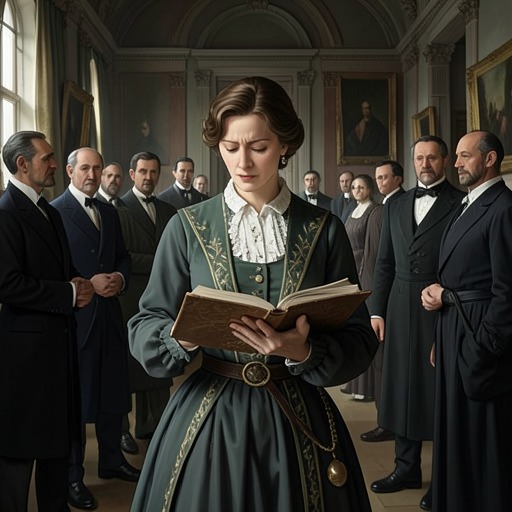
The ending of The Portrait of a Lady provides the book’s most direct account of renunciation. Isabel Archer stays with her husband, Osmond, although she does not love him, knows he has manipulated her, and is free to leave. The book rejects the explanation that she remains simply because convention demands it. Isabel has shown that she can override convention when she chooses; her decision is instead connected to the bond of her word and to a choice she understands as made from her own independence.
That account makes the decision difficult rather than exemplary in an uncomplicated sense. Isabel’s staying does not certify that Osmond deserves her loyalty, and it is not presented as submission to a higher moral authority. The argument is that leaving would also mean disowning a decision that Isabel regards as her own. Her renunciation thus preserves a relation to autonomy even as it binds her to a repulsive husband. The act cannot be measured by whether it secures happiness or escapes manipulation; its force lies in the unresolved relation between the choice she made and the freedom she would exercise by undoing it.
For the book, the absence of transcendence is essential. Isabel’s act is not proof of religious devotion, nor does it gain meaning from a promised reward beyond the world. It is an empty gesture in a Godless universe: a sacrifice of what matters that is not redeemed by an ultimate purpose. This reading connects Henry James on sacrifice to the book’s broader account of materialism, in which renunciation can occur without the guarantee that suffering serves a larger plan.
Advice, Sacrifice, and the Master
The Lesson of the Master presents another reversal. Paul Overt, a young novelist, meets the established writer Henry St. George, who advises him to remain single because a wife would hinder his writing. When Paul asks whether a woman could understand and share in such a sacrifice, St. George answers that women themselves are the sacrifice. Paul follows the advice and gives up Marian, whom he passionately loves. After returning to London from a trip to Europe, he learns that, following the sudden death of his wife, St. George is about to marry Marian.
Paul accuses St. George of shameful conduct, but the older writer maintains that his advice was right: he will not write again, whereas Paul will achieve greatness. The scene places the authority of the advice under pressure from the adviser’s own conduct. St. George does not simply model the rule he gave Paul. The book nevertheless interprets his action not as cynical wisdom but as something like the analyst’s position: he is able to profit from his ethical choices and thereby break the cycle in which ethical commitment is continually proved through sacrifice.
That interpretation complicates the familiar expectation that a teacher must embody the lesson in a life that matches it. St. George’s counsel may be right for Paul even though St. George himself does not continue to follow it. The gap between what is said and what the speaker does is not automatically evidence that the speech is fraudulent; in the book’s reading, the scene asks what kind of authority can produce an effect without resting on the speaker’s exemplary conduct. Henry James on sacrifice thus supplies an ethical problem rather than a simple moral: renunciation can be urged by someone who does not make the same renunciation, and the difference unsettles the assumed bond between advice, virtue, and personal example.
Related Literary Motifs
The book also places Henry James on sacrifice within a wider repertoire of unstable objects and withheld meanings in his fiction. It identifies the lost manuscript or packet of letters as a recurring narrative object around which a story can circulate, and points to the pearls in Paste, whose uncertain authenticity threatens family honor. In another register, the beast in The Beast in the Jungle is given as an example of a traumatic, impossible thing that threatens to engulf the subject. These examples broaden the significance of the earlier painter’s difficulty: objects in these stories do not simply carry fixed meanings but organize uncertainty, secrecy, and the characters’ relation to what cannot be securely known.
Across these cases, Henry James on sacrifice matters because his fiction does not make ethical significance depend on a stable appearance, an exemplary speaker, or a guaranteed reward. The real can look false; a freely made decision can bind its maker; and advice can retain force despite the adviser’s divergent conduct. The book uses those reversals to show how literary form can disclose a materialist ethics: not a settled code, but a difficult responsibility formed in the absence of any final guarantee.